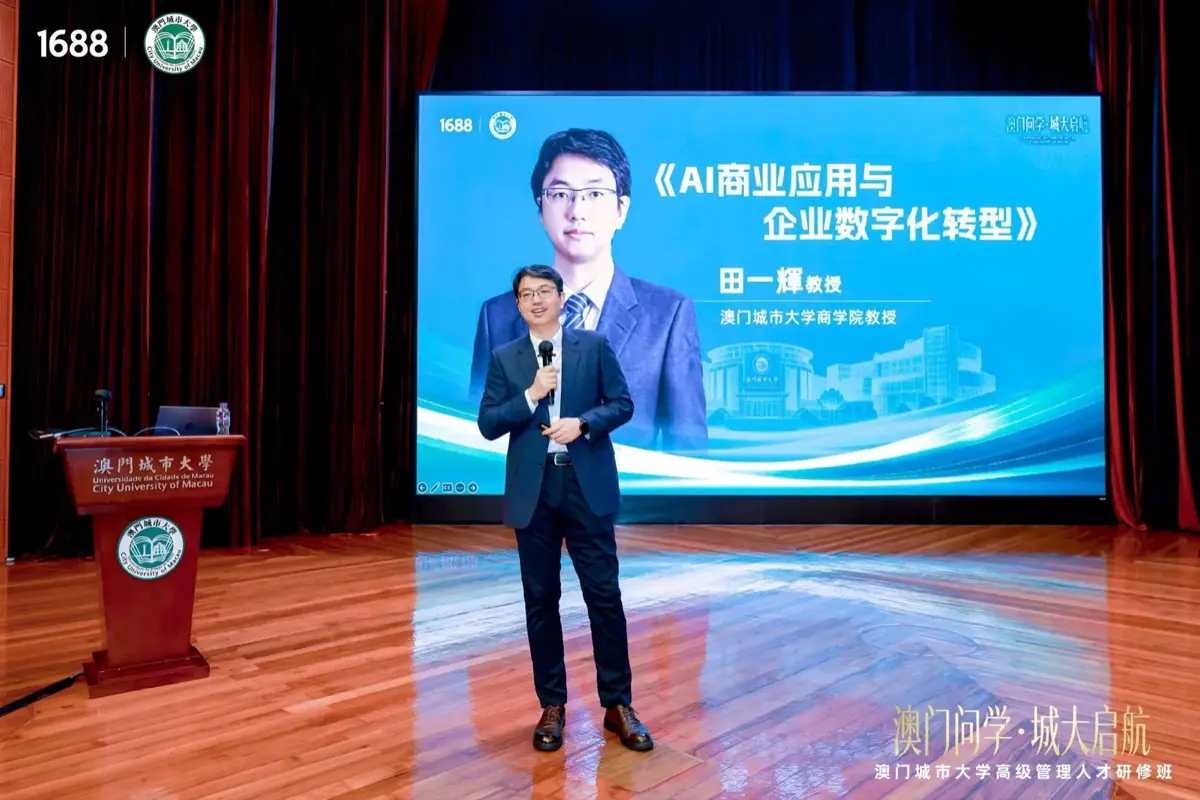
Zhejiang Goods, the Macao Interface, Portuguese-Speaking Markets — Vice President Tian Yihui Lectures at the 1688 Super Factory CEO Class
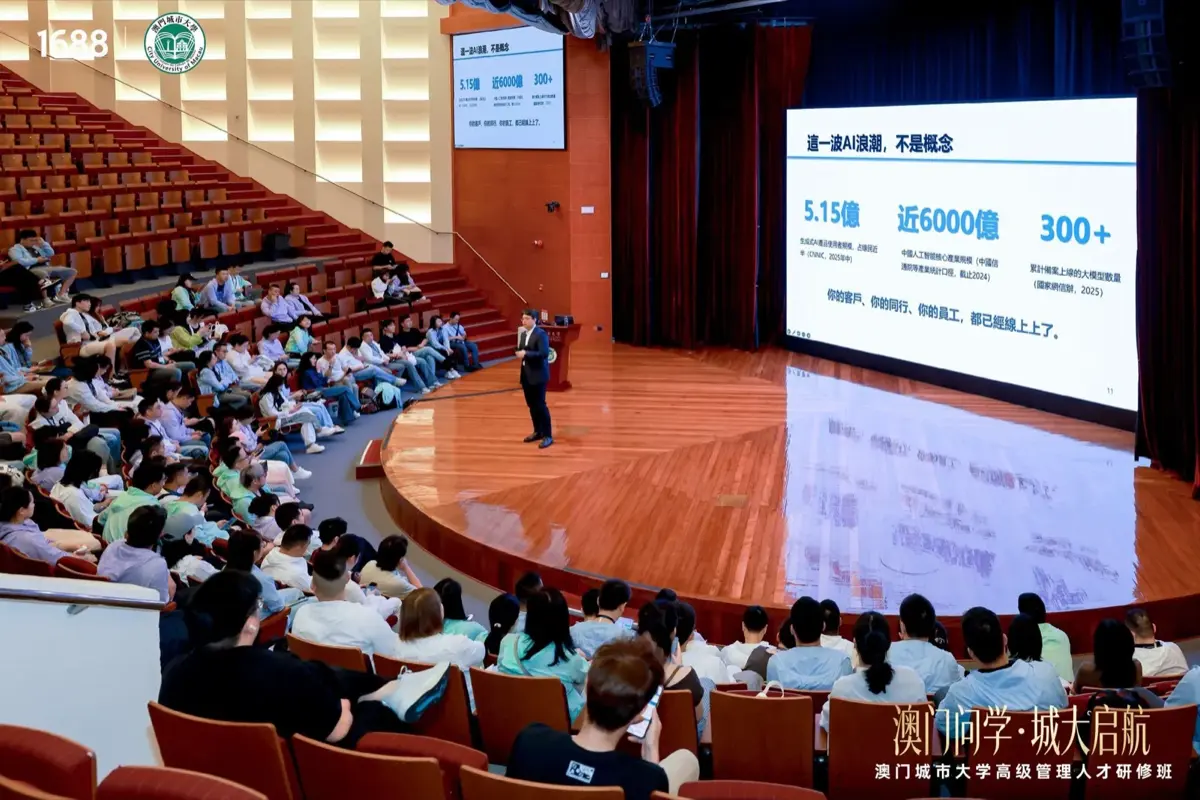
From 14 to 16 September, the 63rd session of the Alibaba 1688 Super Factory CEO Class, “Learning in Macao · Setting Sail at CityU”, was held at the City University of Macau, bringing together 200 manufacturing business owners — mostly from Zhejiang's industrial belts — with annual revenues between RMB 30 million and RMB 200 million. On the closing day, Professor Tian Yihui delivered a keynote titled “AI Business Applications and Enterprise Digital Transformation”, offering pragmatic guidance around five questions: why transform, what to transform, where AI fits, how to implement it, and where to go next.
Why now? Three tipping points arriving at once
Start with users. According to the China Internet Network Information Center (CNNIC), users of generative AI products in China grew from 230 million in mid-2024 to 515 million in mid-2025 — a 124% increase in one year — and exceeded 600 million by the end of 2025, accounting for 42.8% of internet users. Your customers are already using AI to compare prices and find suppliers, and your employees can use AI with virtually no training. The market has completed the “user education” stage for you.
Next, costs. Stanford's AI Index 2025 shows that the cost of querying a model at the GPT-3.5 level fell from about US$20 per million tokens in November 2022 to roughly US$0.07 by October 2024 — a drop of more than 280-fold in 18 months. Processing a million characters of text now costs the equivalent of just a few jiao in RMB. The last excuse of “unaffordability” no longer exists.
Finally, policy. “AI Plus” has been written into the 2025 Report on the Work of the Government, and the State Council's Opinions on Further Implementing the “AI Plus” Initiative make it clear that the intelligent economy should become a new engine of economic development by 2027 and rank among the world's leaders by 2030. By the end of 2024, China's core AI industry had reached nearly RMB 600 billion in scale.
Every technological revolution first rewards those who act and then punishes those who wait. So it was with the steam engine, with electricity and with the internet — and AI will be no exception, except that this cycle is shorter and the gap wider.
What to transform? From experience-driven to data-driven
Digital transformation is not about buying software; it is about doing business in a different way. Over the past three decades, factories have climbed two steps: informatization moved paper documents into computers, solving “bookkeeping”; digitalization moved transactions onto 1688 and cross-border platforms, solving “visibility”. Since 2023, a third step has begun — intelligentization: AI directly participates in product selection, pricing, stocking and production scheduling, turning data from a “record” into a “command”.
Most factories are still stuck between the first and second steps. An experience-driven factory picks products by intuition, stocks by feel, staffs customer service with headcount and decides from memory; a data-driven factory selects products by data, stocks by forecast, serves customers around the clock and lets the owner watch a dashboard. The same plant and equipment can lead to two very different outcomes.
Three misconceptions to avoid in advance: buying software does not equal transformation; there is no moment when AI is “mature”; and transformation cannot be outsourced to IT — it is a top-leader project, and the boss is the only person who can make it happen.
Where does AI fit? Four capabilities, six scenarios
First, be clear about what AI can do: it can read (classifying contracts, customs declarations and negative reviews in seconds), create (copy, images, videos and multilingual content), reason (linking sales, inventory and costs into recommendations) and respond (assisting customer service, livestreaming and negotiations).
Applied to the factory value chain, that means six scenarios:
R&D and design: AI produces concept images in batches and 3D rendering replaces part of physical sampling, compressing the new-product cycle from months to weeks;
Marketing and customer acquisition: AI-generated product images, digital-human livestreams and short-video pipelines turn daily updates from “impossible” into “too much to keep up with”;
Production and operations: visual quality inspection, intelligent scheduling and equipment early-warning are mature, no-longer-mysterious applications;
Business decision-making: demand forecasting and stocking optimization — a digital advisor at the owner's side;
Stocking and product selection: historical sales plus seasonality plus promotions let AI recommend stocking, and once inventory turns faster, cash flow comes back;
Knowledge assets: feed process parameters, pricing logic and factory-audit standards into a corporate knowledge base, so new employees “start work with ten years of experience”.
Behind these scenarios are businesses already running for real. A shop owner in the Yiwu International Trade City uses AI digital humans for cross-border livestreaming: recording one video in Chinese generates versions in dozens of languages, turning one person into a “global anchor”. Cross-border e-commerce imports and exports grew from RMB 1.62 trillion in 2020 to RMB 2.75 trillion in 2025, up 69.7% in five years — on the General Administration of Customs' measure, this curve is the most realistic window for small and medium-sized factories to go global. SHEIN tests styles with first orders of 100–200 pieces and reorders immediately when the data is good; Rhino Manufacturing accepts orders from 100 pieces with delivery in about seven days. “Small orders, quick response” is not a concept but an inventory revolution that turns “betting on styles” into “testing styles”.
Tech mini-class: three words — LLM, RAG, Agent
A large language model (LLM) is a “general-knowledge brain” that has read the entire web: it can read, write and interpret images, but it does not naturally know your factory. Retrieval-augmented generation (RAG) makes AI look up your knowledge base before composing an answer — shifting it from “common sense” to “your processes, your quotes”. An agent breaks down tasks on its own, calls tools and executes to the end: checking inventory, calculating replenishment, sending approvals, all in one chain. From 2025 onward, this is the main battleground of enterprise AI competition.
In one sentence: the knowledge base is the foundation, RAG is the plumbing, and the agent is the foreman who gets the work done.
How to implement? Ninety days — fight a battle with visible numbers
Skip the “big and comprehensive” plan; fight a campaign that shows results in 90 days. Days 1–30: pick a scenario that is “high-frequency, low-risk and data-rich” (such as product images or customer-service scripts), record current costs and time as the baseline, form a three-person team, and have the boss check in weekly. Days 31–60: embed AI into real workflows while organizing quotes, processes and FAQs into the knowledge base. Days 61–90: calculate ROI against the baseline, then codify the SOP and replicate it to adjacent scenarios.
Four pitfalls to avoid in advance: never feed core data directly into public large models; keep records of AI-generated content and mind intellectual property; AI can “talk nonsense with a straight face”, so key figures must be manually double-checked; and make it clear to staff that this is “efficiency without layoffs” — only then will frontline workers teach you the real processes.
Four things you can do back at the factory tomorrow: give every core team member an AI assistant and start using it; pick one scenario under the three principles and make a 90-day pact; start building the corporate knowledge base; and book slots at the Canton Fair, the Shenzhen cross-border e-commerce expo and Macao's MIF, securing your outbound interface in advance.
Where next after transforming? Macao, the Greater Bay Area and the Portuguese-speaking countries
The ceiling of a business depends on how large you draw the map. In 2023 the Guangdong–Hong Kong–Macao Greater Bay Area's aggregate economy surpassed RMB 14 trillion, and Guangdong's digital economy exceeded RMB 7 trillion in 2024, ranking first in China for many consecutive years. According to the International Federation of Robotics (IFR), China's manufacturing robot density reached 470 units per 10,000 employees in 2023 — surpassing Germany and Japan to rank third globally — and by the end of 2024 more than two million industrial robots were in operation. The hardware foundation for replacing manual labor is in place; the next layer of value lies in AI decision-making.
Macao holds the positioning bestowed by the nation as “one center, one platform, one base”: a world centre of tourism and leisure, a service platform for commercial and trade cooperation between China and the Portuguese-speaking countries, and a base for exchange and cooperation in which Chinese culture is the mainstream and diverse cultures coexist. The Portuguese-speaking countries number nine, with a combined population of over 300 million — Brazil alone has more than 200 million — and in 2025 total goods trade between China and the Portuguese-speaking countries reached about US$225.79 billion. Combined with the policy benefits of the Guangdong–Macao In-Depth Cooperation Zone in Hengqin, which began closed-border operations under a two-line management model in March 2024, an outbound route of “Zhejiang factories — Greater Bay Area corridor — Macao interface — Portuguese-speaking markets” is clearly visible.